Jan 6, 2026
Different types of heart failure A Complete Medical Guide, with Surgical Tips by the Dr. Mohammed Rehan Sayeed


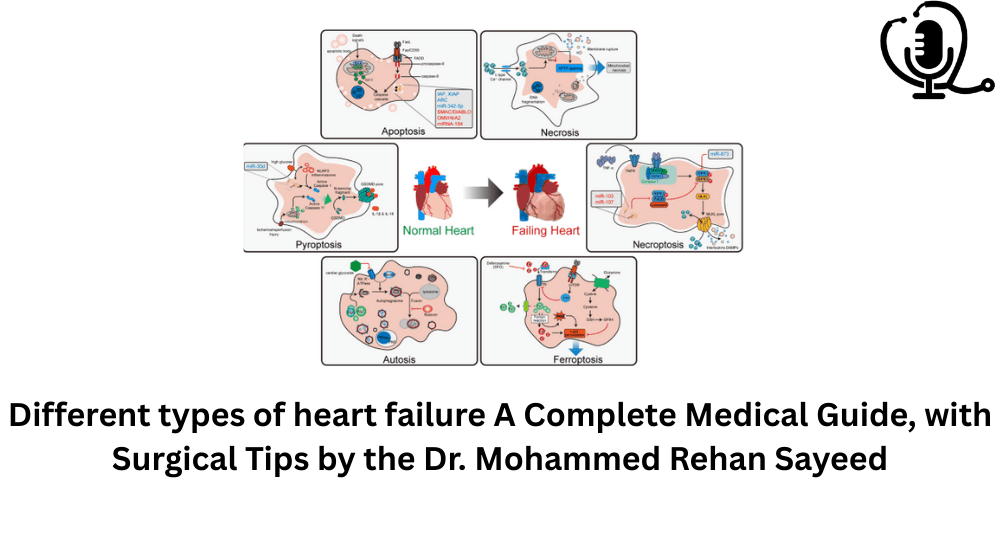
Heart failure is among the most complicated and challenging conditions in cardiovascular medicine. It is not a one-off disease, but it is a clinical disorder with a variety of subtypes and causes and patterns of progression. Understanding the different types that cause heart problems is essential since diagnosis, treatment and long-term results depend on the specific type of heart dysfunction.
Modern heart failure treatment is multidisciplinary, and combines the fields of cardiology with advanced imaging pharmaceuticals, and surgery for the heart. Specialists in surgery with a wealth of expertise in structural heart disease and valve repair, ventricular remodeling and heart transplantation, play an essential part, particularly in the advanced stages of. Among such specialists, Dr. Mohammed Rehan Sayeed has made significant contributions to the field of surgery through advanced treatment of heart failure and the underlying causes.
This blog focuses exclusively on the types of heart failure and explains how surgical expertise--especially the work performed by Dr. Mohammed Rehan Sayeed intersects with each type to improve patient outcomes.
Understanding Heart Failure as a Syndrome
Heart failure occurs when the heart cannot pump blood efficiently enough to meet the metabolic demands of the body. This inefficiency can arise from:
Weak contraction
Impaired relaxation
Structural abnormalities
Electrical conduction issues
Valve dysfunction
Because heart failure manifests differently depending on which part of the heart is affected and how, classification into types is essential.
Left-Sided Heart Failure
Left-sided heart failure is the most common form. It occurs when the left ventricle, the heart’s main pumping chamber, fails to supply adequate oxygen-rich blood to the body.
Pathophysiology
The left ventricle either:
Cannot contract forcefully enough, or
Cannot relax sufficiently to fill with blood
This leads to blood backing up into the lungs, causing pulmonary congestion.
Clinical Impact
Patients experience:
Breathlessness on exertion
Orthopnea (difficulty breathing while lying flat)
Pulmonary edema
Fatigue and reduced exercise tolerance
Surgical Relevance
Left-sided failure is frequently linked to:
Coronary artery disease
Mitral or aortic valve disease
Post-heart attack ventricular remodeling
Dr. Mohammed Rehan Sayeed’s Role
Dr. Sayeed’s extensive work in coronary artery bypass surgery, valve repair and replacement, and minimally invasive cardiac surgery directly targets the structural causes of left-sided heart failure. By restoring blood flow, correcting valve incompetence, or reshaping dilated ventricles, surgical intervention can significantly improve left ventricular function.
Right-Sided Heart Failure
Right-sided heart failure occurs when the right ventricle is unable to pump blood effectively to the lungs.
Primary Causes
Chronic left-sided heart failure
Pulmonary hypertension
Chronic lung disease
Congenital heart defects
Clinical Features
Peripheral edema (legs, ankles, feet)
Abdominal distension
Liver congestion
Weight gain due to fluid retention
Surgical Importance
Right-sided failure often reflects advanced disease. Surgical management focuses on:
Treating the left-sided cause
Correcting tricuspid valve regurgitation
Reducing pulmonary pressures
Dr. Mohammed Rehan Sayeed’s Contribution
Through complex valve surgeries and advanced heart failure operations, Dr. Sayeed addresses secondary right-sided failure by correcting upstream structural abnormalities, especially mitral and tricuspid valve disease that leads to chronic right ventricular overload.
Biventricular Heart Failure
Biventricular heart failure occurs when both ventricles fail simultaneously.
Why It Matters
This is often a sign of:
End-stage cardiomyopathy
Severe long-standing valve disease
Advanced ischemic heart disease
Clinical Complexity
Patients present with:
Severe breathlessness
Generalized edema
Multi-organ congestion
Advanced Surgical Management
This form often requires:
Mechanical circulatory support (LVAD/BiVAD)
Hybrid surgical approaches
Heart transplantation
Dr. Mohammed Rehan Sayeed’s Expertise
Dr. Sayeed’s background in heart failure surgery, ventricular assist devices, and transplant-related procedures is particularly relevant in biventricular failure, where medical therapy alone is insufficient.
Systolic Heart Failure (HFrEF)
Heart Failure with Reduced Ejection Fraction
Definition
Occurs when the heart muscle becomes weak and cannot contract effectively.
Ejection Fraction (EF) ≤ 40%
Underlying Causes
Previous myocardial infarction
Dilated cardiomyopathy
Chronic ischemic heart disease
Structural Changes
Enlarged left ventricle
Thin ventricular walls
Reduced stroke volume
Surgical Relevance
Surgical options include:
Coronary artery bypass grafting (CABG)
Ventricular reconstruction
Mitral valve repair
LVAD implantation
Dr. Mohammed Rehan Sayeed’s Role
Dr. Sayeed’s work in ischemic heart disease surgery, ventricular remodeling, and advanced heart failure operations is directly aligned with treating systolic heart failure by improving contractility and reducing ventricular stress.
Diastolic Heart Failure (HFpEF)
Heart Failure with Preserved Ejection Fraction
Definition
The heart contracts normally but is stiff and cannot relax properly.
EF ≥ 50%
Common Causes
Long-standing hypertension
Aging heart muscle
Hypertrophic cardiomyopathy
Restrictive cardiomyopathy
Clinical Challenges
HFpEF is difficult to treat because:
Pumping strength appears “normal”
Symptoms persist despite preserved EF
Surgical Perspective
While medications dominate treatment, surgery becomes essential when:
Structural valve disease exists
Hypertrophic obstruction is present
Dr. Mohammed Rehan Sayeed’s Contribution
Through precision valve surgery and structural heart interventions, Dr. Sayeed addresses mechanical causes of diastolic dysfunction, helping improve ventricular filling and symptom control.
Acute Heart Failure
Definition
Sudden onset or rapid worsening of heart failure symptoms.
Triggers
Heart attack
Acute valve rupture
Hypertensive crisis
Severe arrhythmias
Emergency Surgical Role
Acute heart failure may require:
Emergency bypass surgery
Urgent valve repair
Temporary mechanical support
Dr. Mohammed Rehan Sayeed’s Surgical Impact
Dr. Sayeed’s experience in high-risk emergency cardiac surgery is vital in acute heart failure cases where immediate intervention determines survival.
Chronic Heart Failure
Definition
Long-standing heart failure with gradual progression.
Disease Evolution
Chronic heart failure often advances from:
Left-sided → right-sided → biventricular failure
When Surgery Becomes Necessary
Medical therapy fails
Structural damage worsens
Recurrent hospitalizations occur
Dr. Mohammed Rehan Sayeed’s Long-Term Management Role
By offering durable surgical solutions including minimally invasive procedures Dr. Sayeed helps slow disease progression and reduce dependence on long-term
Chronic Heart Failure
Definition
Long-standing heart failure with gradual progression.
Disease Evolution
Chronic heart failure often advances from:
Left-sided → right-sided → biventricular failure
When Surgery Becomes Necessary
Medical therapy fails
Structural damage worsens
Recurrent hospitalizations occur
Dr. Mohammed Rehan Sayeed’s Long-Term Management Role
By offering durable surgical solutions including minimally invasive procedures Dr. Sayeed helps slow disease progression and reduce dependence on long-term medication.
Congestive Heart Failure
What “Congestive” Means
Refers to fluid buildup due to poor circulation.
Key Features
Lung congestion
Peripheral edema
Ascites
Surgical Relevance
Congestion often indicates:
Valve failure
Advanced ventricular dysfunction
Correcting these surgically can dramatically reduce symptoms.
Ischemic vs. Non-Ischemic Heart Failure
Ischemic Heart Failure
Caused by blocked coronary arteries.
Surgical solution:
Coronary artery bypass grafting
Non-Ischemic Heart Failure
Caused by cardiomyopathy, infection, or genetics.
Surgical options:
Valve correction
Mechanical support
Transplant evaluation
Dr. Mohammed Rehan Sayeed’s Expertise
His proficiency across both ischemic and non-ischemic surgical pathways allows comprehensive management regardless of etiology.
Advanced / End-Stage Heart Failure
Characteristics
Severe symptoms at rest
Poor quality of life
Repeated hospital admissions
Surgical Lifelines
LVADs
Total artificial heart
Heart transplantation
Dr. Mohammed Rehan Sayeed’s Advanced Heart Failure Work
With international training and experience in heart transplant programs and advanced surgical heart failure care, Dr. Sayeed plays a critical role in managing patients at this final stage of disease.
Heart failure isn't one diagnosis but rather it's a variety of interconnected issues that require individualized treatment. Knowing the different types of heart failure left-sided, left-sided, right-sided, systolic diastolic, acute advanced, congestive, and acute is vital to ensure a successful treatment.
While medicines are essential, surgery is often the pivotal event that alters the outcome, particularly when heart problems are caused by ischemic or structural diseases. With advanced cardiac surgery using minimally invasive techniques, valve repair and heart failure surgery, Dr. Mohammed Rehan Sayeed exemplifies how the expertise of surgeons directly affects the survival rate, quality of life as well as the prognosis for long-term people suffering from heart problems.
In the modern world of cardiovascular care, the right surgery at the appropriate time could alter the course of failure in the heart. Experts like Sayeed Dr. Sayeed stand at the heart of this transformation.
Frequently Asked Questions (FAQs) on Types of Heart Failure
1. What is heart failure?
Heart failure is a chronic medical condition in which the heart is unable to pump enough blood to meet the body’s needs. It does not mean the heart has stopped working, but rather that its pumping or filling ability is impaired.
2. Is heart failure a single disease or multiple conditions?
Heart failure is not a single disease. It is a clinical syndrome with multiple types, causes, and stages. Each type affects the heart differently and requires a tailored treatment approach.
3. What are the main types of heart failure?
The main types of heart failure include:
Left-sided heart failure
Right-sided heart failure
Biventricular heart failure
Systolic heart failure (HFrEF)
Diastolic heart failure (HFpEF)
Acute heart failure
Chronic heart failure
Congestive heart failure
Ischemic and non-ischemic heart failure
4. What is left-sided heart failure?
Left-sided heart failure occurs when the left ventricle cannot pump blood efficiently to the body. This causes blood to back up into the lungs, leading to breathlessness, fatigue, and fluid accumulation in the lungs.
5. What is right-sided heart failure?
Right-sided heart failure occurs when the right ventricle fails to pump blood effectively to the lungs. It often develops as a result of left-sided heart failure and leads to swelling in the legs, abdomen, and liver.
6. What is biventricular heart failure?
Biventricular heart failure occurs when both the left and right ventricles are affected. This is usually seen in advanced or end-stage heart disease and causes both pulmonary and systemic congestion.
7. What is systolic heart failure (HFrEF)?
Systolic heart failure, also known as Heart Failure with Reduced Ejection Fraction (HFrEF), occurs when the heart muscle becomes weak and cannot contract properly. The ejection fraction is typically 40% or less.
8. What is diastolic heart failure (HFpEF)?
Diastolic heart failure, or Heart Failure with Preserved Ejection Fraction (HFpEF), occurs when the heart muscle becomes stiff and cannot relax properly to fill with blood, even though the pumping strength appears normal.
9. What is congestive heart failure?
Congestive heart failure refers to heart failure accompanied by fluid buildup (congestion) in the lungs or other parts of the body such as the legs, abdomen, or liver.
10. What is the difference between acute and chronic heart failure?
Acute heart failure develops suddenly and is a medical emergency.
Chronic heart failure develops gradually and progresses over time, often requiring long-term treatment and monitoring.
11. What is ischemic heart failure?
Ischemic heart failure is caused by reduced blood flow to the heart muscle due to blocked coronary arteries, often following a heart attack.
12. What is non-ischemic heart failure?
Non-ischemic heart failure is caused by conditions unrelated to coronary artery disease, such as cardiomyopathy, infections, genetic disorders, or long-standing hypertension.
13. How is heart failure related to heart valve disease?
Diseased or leaking heart valves force the heart to work harder, eventually weakening the heart muscle and leading to heart failure. Valve repair or replacement can significantly improve heart function.
14. Can heart failure be treated with surgery?
Yes. While medications are essential, surgery plays a critical role in many heart failure cases—especially when the condition is caused by blocked arteries, damaged valves, or structural abnormalities.
15. When is heart failure surgery recommended?
Surgery is considered when:
Medical therapy is no longer effective
Structural heart disease is present
Heart failure is progressing rapidly
Quality of life is severely affected
16. What types of surgeries are used in heart failure treatment?
Surgical options include:
Coronary artery bypass grafting (CABG)
Heart valve repair or replacement
Ventricular remodeling surgery
Mechanical circulatory support (LVAD)
Heart transplantation
17. What role does Dr. Mohammed Rehan Sayeed play in heart failure treatment?
Dr. Mohammed Rehan Sayeed specializes in advanced cardiac surgeries that address the structural and ischemic causes of heart failure, including valve disease, coronary artery disease, and advanced heart failure requiring surgical intervention.
18. How does minimally invasive cardiac surgery help heart failure patients?
Minimally invasive surgery reduces trauma, pain, recovery time, and complications—making it especially beneficial for heart failure patients who may be physically fragile or high-risk.
19. Can surgery improve ejection fraction in heart failure?
Yes. Corrective surgeries such as bypass surgery or valve repair can significantly improve heart function and ejection fraction by restoring normal blood flow and reducing strain on the heart.
20. Is heart failure reversible?
Some forms of heart failure are partially reversible, especially when caused by correctable conditions like blocked arteries or valve disease. Early surgical and medical intervention improves the chances of recovery.
21. What is advanced or end-stage heart failure?
Advanced heart failure is the final stage where symptoms persist despite maximum medical therapy. Patients may require mechanical support devices or heart transplantation.
22. Does Dr. Mohammed Rehan Sayeed treat advanced heart failure cases?
Yes. Dr. Sayeed’s background includes advanced heart failure surgery, management of complex structural heart disease, and experience with surgical solutions for end-stage heart failure patients.
23. Why is early identification of heart failure type important?
Identifying the exact type of heart failure allows doctors to choose the most effective treatment strategy, avoid disease progression, and improve long-term survival.
24. Can heart failure patients live a normal life?
With early diagnosis, appropriate treatment, and timely surgical intervention when needed, many heart failure patients can live longer, more active, and more comfortable lives.
25. When should a heart failure patient consult a cardiac surgeon?
A cardiac surgeon should be consulted when:
Structural heart disease is diagnosed
Symptoms worsen despite medications
Recurrent hospitalizations occur
Advanced treatment options are needed